Kedgeree is the very first dish served on Downton Abbey. Mrs. Patmore sends a steaming bowl up for breakfast, and with that we're immersed in the sumptuous world of Edwardian cuisine. Brits still eat kedgeree today, and it's one of those dishes that carries a few hundred years of British history along with it. Plus, the name is fascinating, since it directly reflects British colonialism.
Kedgeree originated as khichri, an Indian meal of rice and lentils, often served with chopped, hard-boiled egg. During British occupation of India, the English adapted the dish to their own tastes and eventually brought it back to the home country, where it caught on as a breakfast food. Kedgeree, as it became known (note the Anglicization), featured rice, fish, and egg, with a variety of spices and garnishes depending on the recipe. It was a great way for cooks to use up leftovers in the days before refrigeration, and it was seen as a rather "adventurous" dish. By the time Mrs. Patmore served it at Downton, kedgeree was entrenched in the British breakfast menu.
To make my own, I turned to Mrs. Beeton, that domestic goddess of the Victorian era. Surely, if anyone knew how to make kedgeree, it would be she. But after following her recipe to the letter, I did some comparison research and discovered that she is basically the only person who made it this way.
Beeton calls for leftover rice, "any cold fish," and two soft-boiled eggs, along with assorted seasonings and mustard. Every other recipe I've found, historic and modern, calls for smoked fish and hard-boiled eggs, with mustard seeds (or none at all). These are subtle but noticeable differences, friends. I can't help wondering if this is one of those old recipes where you really had to know what the writer meant in order for the dish to turn out remotely well. Like, did Mrs. Beeton mean "mustard seeds" when she called for mustard? Did "soft-boiled eggs" back in the Victorian day actually mean "hard-boiled"? In other words, is this recipe just code for a completely different recipe?
We'll just have to keep on wondering.
I've set down my version of Beeton's recipe below, and it's not bad. I used cod, which has a pleasant, mildly fishy flavor, and the seasonings and egg actually blend nicely. But it bears little resemblance to anything that originated in India.
Kedgeree
(adapted from Mrs. Beeton's Book of Household Management)
1/2 lb cod fillet
1 1/3 cup brown rice, cooked
2 tsp mustard
2 eggs
1 tsp butter, cubed
salt and cayenne pepper, to taste
To make the fish:
Set the fish in a pot and cover with cold water. Set the pot over a high flame and bring to a boil. Immediately remove from the heat and let sit for ten minutes. Remove the fish and let cool.
To make the eggs:
Boil a small pot of water over high heat. As soon as the water boils, turn the heat down to a simmer. Crack the eggs in a small bowl and slip into the hot water, using the side of the pot to guide the eggs into the water so they don't break. Cook for 5 minutes and remove from water.
To make the kedgeree:
Flake the cooked fish into small pieces. Mix with the brown rice, mustard, eggs, and butter. Add salt and cayenne pepper to taste. Serve hot.
Showing posts with label grains. Show all posts
Thursday, March 14, 2013
Monday, October 8, 2012
This meal brought to you by Christopher Columbus
Ah, Columbus Day. I'm not sure there's any other secular holiday more filled with angst and mixed feelings than this one.
When I was little, we learned the basics of Columbus Day. We sang that catchy song, the one that goes, "In Fourteen Hundred and Ninety-Two, Columbus sailed the ocean blue..." and read picture books about the brave Spanish navigator who discovered the Americas. To me, Columbus Day always brought to mind the classic image of a stuffy European man, dressed circa the Renaissance, talking pleasantly with smiling natives who are wearing almost nothing. That's how it was taught in elementary school, at any rate.
Turns out the story went a little differently. It wasn't until middle school that I heard the first rumblings of discontent. We read Joy Hakim's entertaining histories, A History of Us, and she hinted that Christopher Columbus was not the hero he was made out to be. And in high school, I learned the full truth. Columbus treated his crew harshly, lied about who saw land first and what they found there, and kidnapped natives to lead him to gold. Later European explorers carried on his legacy by enslaving the native populations of the Americas, killing those who didn't cooperate, and laying the groundwork for future colonization.
Yet other changes were not as obvious. In the spirit of cultural exchange, European explorers took examples of American food, animals, goods, and people back to their kings and queens. In return, they brought European crops, animals, and goods to their new colonies, hoping to replicate European life on foreign soil. There's a fascinating book about how British colonists in Virginia and New England permanently changed the American landscape, simply by using European farming techniques and importing cows and pigs who dug up the soil. Old World crops and animals mixed with New World in both hemispheres. But perhaps the most devastating change was completely invisible: the syphilis, smallpox, and other Old World diseases that spread silently through the Americas. Without built-in immunity to these diseases, the native populations were decimated. Europeans could conquer the land simply by setting foot on it.
This massive exchange of culture, crops, animals, people, and disease was termed the Columbian Exchange by historian Alfred W. Crosby in the 1970s. Not only did it permanently change the newly-"discovered" lands of the Americas, it changed the Old World, too. Today we grow food and raise animals in lands where they didn't originate. It's been such a long time, and they've adapted so well, that most of the time we don't even notice.
So, because I can't leave well enough alone, I decided to cook a Columbian Exchange dinner. What kind of meal could I make using ingredients found mostly at my farmers' market? What would that tell me about the extent of the Exchange?
Quite a lot, as it turns out.
After collecting our goods at the farmers' market and rounding out the ingredients at our local grocery, Josh and I made:
Granted, a little fancier than our normal weekend dinners, but none of the ingredients were particularly exotic. But let's look at how those three dishes break down. Where did their ingredients originate?
When I was little, we learned the basics of Columbus Day. We sang that catchy song, the one that goes, "In Fourteen Hundred and Ninety-Two, Columbus sailed the ocean blue..." and read picture books about the brave Spanish navigator who discovered the Americas. To me, Columbus Day always brought to mind the classic image of a stuffy European man, dressed circa the Renaissance, talking pleasantly with smiling natives who are wearing almost nothing. That's how it was taught in elementary school, at any rate.
Turns out the story went a little differently. It wasn't until middle school that I heard the first rumblings of discontent. We read Joy Hakim's entertaining histories, A History of Us, and she hinted that Christopher Columbus was not the hero he was made out to be. And in high school, I learned the full truth. Columbus treated his crew harshly, lied about who saw land first and what they found there, and kidnapped natives to lead him to gold. Later European explorers carried on his legacy by enslaving the native populations of the Americas, killing those who didn't cooperate, and laying the groundwork for future colonization.
Yet other changes were not as obvious. In the spirit of cultural exchange, European explorers took examples of American food, animals, goods, and people back to their kings and queens. In return, they brought European crops, animals, and goods to their new colonies, hoping to replicate European life on foreign soil. There's a fascinating book about how British colonists in Virginia and New England permanently changed the American landscape, simply by using European farming techniques and importing cows and pigs who dug up the soil. Old World crops and animals mixed with New World in both hemispheres. But perhaps the most devastating change was completely invisible: the syphilis, smallpox, and other Old World diseases that spread silently through the Americas. Without built-in immunity to these diseases, the native populations were decimated. Europeans could conquer the land simply by setting foot on it.
This massive exchange of culture, crops, animals, people, and disease was termed the Columbian Exchange by historian Alfred W. Crosby in the 1970s. Not only did it permanently change the newly-"discovered" lands of the Americas, it changed the Old World, too. Today we grow food and raise animals in lands where they didn't originate. It's been such a long time, and they've adapted so well, that most of the time we don't even notice.
So, because I can't leave well enough alone, I decided to cook a Columbian Exchange dinner. What kind of meal could I make using ingredients found mostly at my farmers' market? What would that tell me about the extent of the Exchange?
Quite a lot, as it turns out.
After collecting our goods at the farmers' market and rounding out the ingredients at our local grocery, Josh and I made:
- Roasted squash and shallot salad
- Pork chops with roasted apples and onions
- German chocolate hazelnut cake
While our dishes were certainly heavy on the Old World influence, it's telling that some of the main ingredients originated in the New World. There's thought that chickens might have originated in both the New World and the Old World (or, really, developed before the Americas were cut off from Eurasia).
The other interesting thing about this is how many of the above ingredients I was able to get at our farmers' market. Providence is big about buying local, and from the Pat's Pastured pork chops to shallots and onions, from apples to sage, a lot of the "Old World" ingredients are now grown "locally" in Rhode Island. I say "locally" because, yes, they are grown in Rhode Island. At this point, for example, apples are practically a native species. But before the Columbian Exchange, you never would have found them here. And that's a sobering reminder of all the other horrific and massive changes that occurred because of it.
Tell me, is there anything on this list that surprises you? And what do you think of Christopher Columbus?
Works cited: Guns, Germs, and Steel by Jared M. Diamond. 1493: Uncovering the World Columbus Created by Charles C. Mann. A People's History of the United States by Howard Zinn. The Columbian Exchange: Biological and Cultural Consequences of 1492 by Alfred W. Crosby, via National Center for History in the Schools instructional resource Three Worlds Meet: The Columbian Encounter and its Legacy.
Labels:
adventure,
books,
cheese,
dessert,
fall,
grains,
history lesson,
holidays,
meat,
vegetables
Monday, September 17, 2012
Harvest
Suddenly it's fall.
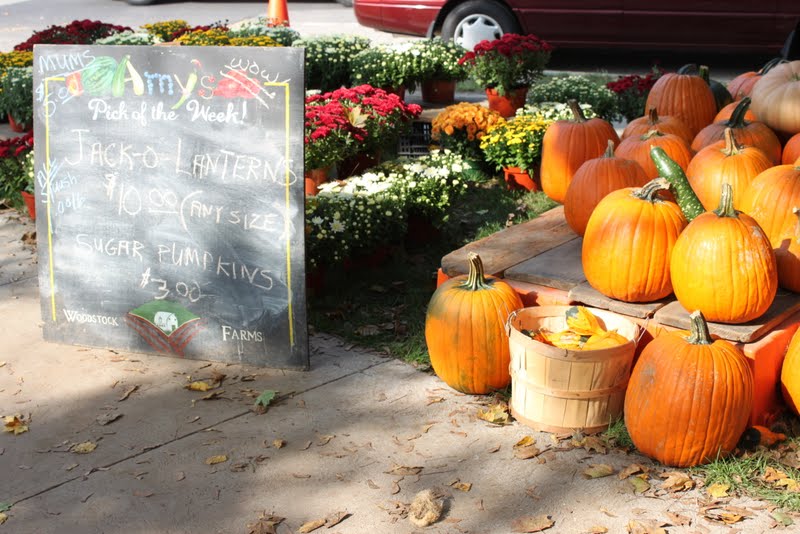
Vendors' stands overflow with corn and pumpkins and squash and apples at the farmers' market. Mornings are chilly enough to put on a warm sweater. Starbucks has switched over to Pumpkin Spice Lattes and Salted Caramel Mochas. Saver's now advertises Halloween costumes. Corporate America is ready to remind you that yes, it's really September, just in case you can't tell.
This afternoon I stopped by a craft store to get some dried flowers and other materials to make a fall wreath, which involved walking by garlands of garish orange leaves and flowers with colors you'd never find in nature. It's funny that big box stores tell us to mark fall, traditionally a time of harvesting natural foods, with fake decorative plants. While I tried to find the least obnoxious materials for my wreath, I think it's still going to feature at least a few plastic grains.
Ah, well.
Recently I've found myself thinking a lot about harvest time and how to stay close to the land and the seasons. My parents visited briefly this weekend, and we walked around the new neighborhood and commented on the abundant gardens people grow here. My parents love to garden, though they seldom can devote as much time as they'd like to their plants. When I was little, they had a big plot in the backyard where they grew corn, squash, tomatoes, and giant pumpkins. There's a picture of me, aged 6 months, sitting on top of a pumpkin that's bigger than I am. Looking at old photos like that, I get the sense that our lives revolved around the garden and the seasons in a way that we've tried to recapture ever since. My dad still tends to a few tomato and cantaloupe plants, and you all know the saga of my own kitchen garden. But there's something about the demanding nature of a big garden that ties you down to the land until you've harvested every last crop.
(I tend to get rather poetical and starry-eyed about the idea of farming. I suspect that if I ever did start my own farm, those romantic notions would never survive.)
So, mind full of dreams and desires to root myself to the earth, I've been looking at some photos from the old garden. The year my sister was born, my parents planted wheat and harvested it at the end of the summer. In a few exhausting days, my grandmother helped my parents reap, thresh, and grind the wheat into flour, that my dad then used to make bread.
It's a great story, one that speaks to my family's strange desire to mimic old-fashioned farming methods.
I love looking at these photos from long ago. There's my sister, just a babe in arms.
There I am, a little two-year-old helping out with the threshing and the bread-making. There are my parents, younger versions of themselves when they had more time to work in the garden. And my grandmother, with whom I wish I could share my growing love of all things crafty and historical.
And this last photo, where my dad is teaching me how to knead bread, which explains everything about this blog.
Happy fall, friends.
Vendors' stands overflow with corn and pumpkins and squash and apples at the farmers' market. Mornings are chilly enough to put on a warm sweater. Starbucks has switched over to Pumpkin Spice Lattes and Salted Caramel Mochas. Saver's now advertises Halloween costumes. Corporate America is ready to remind you that yes, it's really September, just in case you can't tell.
This afternoon I stopped by a craft store to get some dried flowers and other materials to make a fall wreath, which involved walking by garlands of garish orange leaves and flowers with colors you'd never find in nature. It's funny that big box stores tell us to mark fall, traditionally a time of harvesting natural foods, with fake decorative plants. While I tried to find the least obnoxious materials for my wreath, I think it's still going to feature at least a few plastic grains.
Ah, well.
Recently I've found myself thinking a lot about harvest time and how to stay close to the land and the seasons. My parents visited briefly this weekend, and we walked around the new neighborhood and commented on the abundant gardens people grow here. My parents love to garden, though they seldom can devote as much time as they'd like to their plants. When I was little, they had a big plot in the backyard where they grew corn, squash, tomatoes, and giant pumpkins. There's a picture of me, aged 6 months, sitting on top of a pumpkin that's bigger than I am. Looking at old photos like that, I get the sense that our lives revolved around the garden and the seasons in a way that we've tried to recapture ever since. My dad still tends to a few tomato and cantaloupe plants, and you all know the saga of my own kitchen garden. But there's something about the demanding nature of a big garden that ties you down to the land until you've harvested every last crop.
(I tend to get rather poetical and starry-eyed about the idea of farming. I suspect that if I ever did start my own farm, those romantic notions would never survive.)
So, mind full of dreams and desires to root myself to the earth, I've been looking at some photos from the old garden. The year my sister was born, my parents planted wheat and harvested it at the end of the summer. In a few exhausting days, my grandmother helped my parents reap, thresh, and grind the wheat into flour, that my dad then used to make bread.
It's a great story, one that speaks to my family's strange desire to mimic old-fashioned farming methods.
And this last photo, where my dad is teaching me how to knead bread, which explains everything about this blog.
Happy fall, friends.
Subscribe to:
Posts (Atom)